- ZBB or Zero Based Budgeting is a a budgeting process where on a very granular level, you go through a company's spending and determine what resources various business units require. That means looking at individual cost categories across all business units. The process puts the burden of proof on the manager who's asking for resources. He or she must demonstrate almost on a continual basis the reasons the resources are in fact still required to achieve business objectives.
- ZBB is fundamentally different from Cost Cutting initiatives. Standard cost cutting programs typically start with a directive to reduce the previous year's spending levels. As a result, executives naturally focus on the largest expense categories -- the tallest trees in the forest. ZBB instead asks everyone to rebuild their budgets from the bottom up, with no carryover from the preceding years. This process identifies many small pockets of waste that add up to big savings.
- ZBB shifts the burden of proof from those tasked with driving cost reductions (finance team or productivity program management office) to the business leaders and front-line organizations which must contribute to both identifying unproductive costs and eliminating them in practice.
- The whole intent of ZBB is to ensure that right money is behind the right projects.
Thursday, January 31, 2019
ZBB Essentials - Mckinsey


Skunk Works - Lockheed Martin built (the fighter jet) in 143 Days (courtesy Lockheed Martin and red-gate.com)
Quote this example for Agile / Rapid Delivery
- In 1943, the U.S. Army’s Air Tactical Service Command (ATSC) met with Lockheed Aircraft Corporation to express its dire need for a jet fighter to counter a rapidly growing German jet threat.
- Engineer Kelly Johnson and his team designed and built the XP-80 Shooting Star in only 143 days, seven less than was required.
- Kelly's 14 Rules & Practices (some of the 14 rules and practices reflect upon the close analogy to agile practices).
- The Skunk Works® manager must be delegated practically complete control of his program in all aspects. He should report to a division president or higher. -->> AUTONOMY
- The number of people having any connection with the project must be restricted in an almost vicious manner. Use a small number of good people (10% to 25% compared to the so-called normal systems). -->> SMALL TEAMS
- A very simple drawing and drawing release system with great flexibility for making changes must be provided. --> NO BIG UPFRONT DESIGN / SMALL
- There must be a minimum number of reports required, but important work must be recorded thoroughly -->> NO OR MINIMAL DOCUMENTATION
- There must be a monthly cost review covering not only what has been spent and committed but also projected costs to the conclusion of the program. // Funding a program must be timely so that the contractor doesn't have to keep running to the bak to support government projects -->> INCREMENTAL FUNDING (and Review).
- The contractor must be delegated and must assume more than normal responsibility to get good vendor bids for subcontract on the project. Commercial bid procedures are very often better than military ones -->> COLLABORATION OVER CONTRACT NEGOTIATION
- There must be mutual trust between the military project organization and the contractor, the very close cooperation and liaison on a day-to-day basis. This cuts down misunderstanding and correspondence to an absolute minimum. -- >> TRUST / OPENNESS / RESPECT, etc.

Bottomline: This only proves that the Agile principles are indeed tried and tested and not just philosophies of good craftsmanship.
Wednesday, January 30, 2019




Monday, January 28, 2019
Fractals and Agile
Fractalfoundation.org
A fractal is a never-ending pattern. Fractals are infinitely complex patterns that are self-similar across different scales. They are created by repeating a simple process over and over in an ongoing feedback loop. Driven by recursion, fractals are images of dynamic systems – the pictures of Chaos. Geometrically, they exist in between our familiar dimensions. Fractal patterns are extremely familiar, since nature is full of fractals. For instance: trees, rivers, coastlines, mountains, clouds, seashells, hurricanes, etc. Abstract fractals – such as the Mandelbrot Set – can be generated by a computer calculating a simple equation over and over.
A fractal is a never-ending pattern. Fractals are infinitely complex patterns that are self-similar across different scales. They are created by repeating a simple process over and over in an ongoing feedback loop. Driven by recursion, fractals are images of dynamic systems – the pictures of Chaos. Geometrically, they exist in between our familiar dimensions. Fractal patterns are extremely familiar, since nature is full of fractals. For instance: trees, rivers, coastlines, mountains, clouds, seashells, hurricanes, etc. Abstract fractals – such as the Mandelbrot Set – can be generated by a computer calculating a simple equation over and over.


Mathematical fractals are generated by applying a feedback loop to a system.
Z = Z2 + C
Tathagat Varma.
- Mathematical fractals unlike natural fractals can keep self repeating indefinitely.
- They are the best examples of - Simplicity leads to complexity.
- They appear complex, but are essentially repeating a basic shape repeatedly, infinitely.
- Fractals are nature's mechanism to replicate organization without exhibiting a central control.
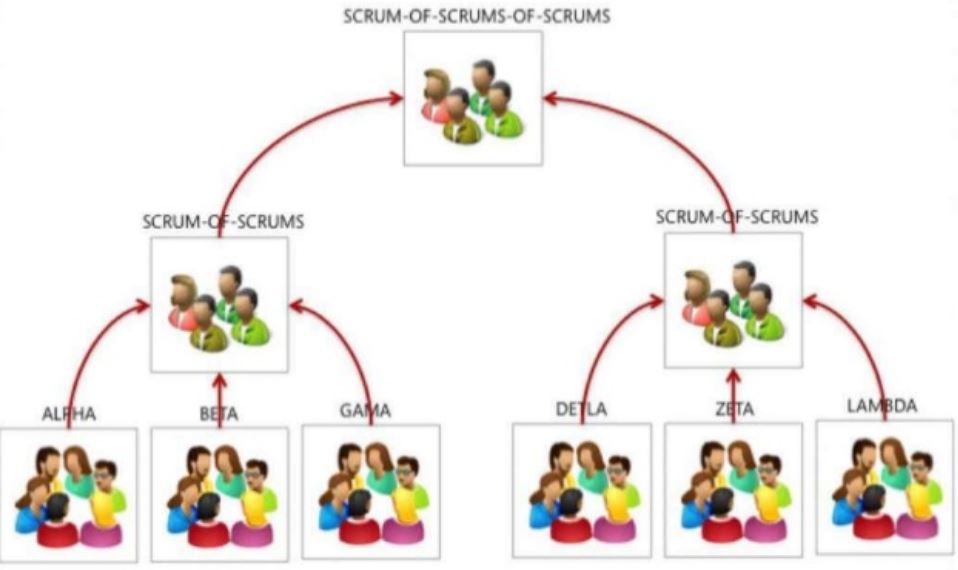
- Agility could be modeled as a fractal behaviour of software teams to ensure the core focus on agility loop is always retained, despite scale.
- In practice, the notion of agility at each level would undergo changes but the core behavior of agility loop gets preserved, and allows agility to grow scale free!
How Agile relates to Fractals
=====================

Friday, January 25, 2019
Agile Cereal Box for Product Vision
- Source - Reqtest.com
- Product vision describes the product’s goals and customer value. It relates to the problem that the product solves.
- Vision improves clarity.
- A good vision can be used to accept or reject requirements.
- Product vision box was introduced by Jim Highsmith and can be used for both traditional as well as Agile projects.
- Basic idea: create and actual physical box that has to be used to market the product. Common analogy is a Cereal Box.
- Divide team into two. Multiple boxes. Series of intermediate boxes.
- Takes 40 minutes to 1 hour.
- Front - product name with picture or drawing, slogan, and three to four main selling points.
- Back - a more detailed view of the product, listing functionality, requirements, etc.

Subscribe to:
Posts (Atom)


